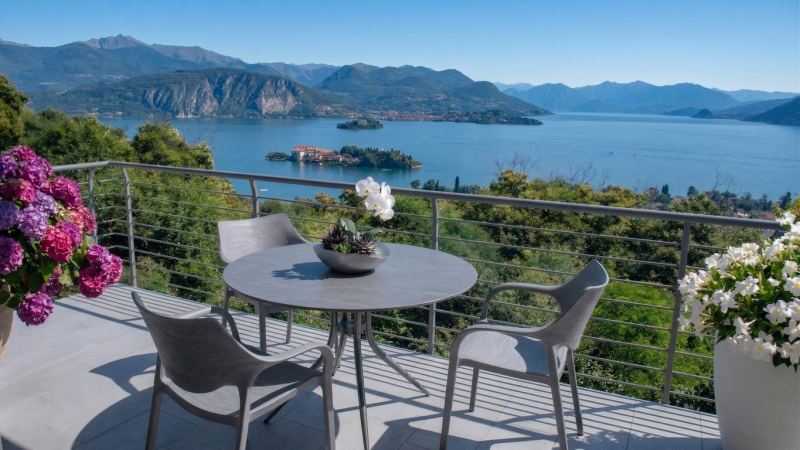
Purchasing a luxury villa on Lake Maggiore is not just about choosing an extraordinary place to live or spend your leisure time: it also means navigating a path that requires fiscal awareness, especially when dealing with prestigious properties.
Lake Maggiore attracts both Italian and international buyers, investors, entrepreneurs, and families seeking exclusive properties in Stresa, Baveno, Verbania, or Arona. For all of them, understanding Italian real estate taxation is a fundamental step in planning a secure and advantageous purchase.
Below is a complete, clear, and updated overview of the main fiscal aspects to consider when buying a luxury villa on Lake Maggiore.
Purchase Taxes: What to Really Expect
When buying a luxury villa, taxes vary based on the type of property and the nature of the seller. Luxury villas often fall under cadastral categories A/1, A/8, or A/9, which entails a specific tax regime.
Purchase from a private individual: The main tax is the Registration Tax, calculated at 9% of the revalued cadastral value. In addition, mortgage and cadastral taxes are generally applied as fixed fees.
Purchase from a construction company: Particularly within five years of the completion of works, VAT at 22% applies, which is typical for high-end luxury properties.
For those wishing to purchase a villa on Lake Maggiore as a second home, it is important to note that "First Home" (Prima Casa) tax breaks do not apply to luxury properties. This is not an obstacle, but rather an element to be factored into financial planning.
Foreign Buyers: Rules, Advantages, and Key Considerations
Lake Maggiore is a favorite destination for international buyers, particularly from Switzerland, Germany, France, the Netherlands, and Scandinavia. For non-residents, Italian law is clear: purchasing a villa is possible without particular restrictions, but it is necessary to obtain an Italian Tax Code (Codice Fiscale) and comply with certain fiscal rules.
Foreign buyers must consider:
- Taxation on income produced in Italy, such as holiday rentals.
- Double taxation agreements between Italy and their home country.
- The possibility of purchasing through companies, trusts, or asset-holding vehicles.
- Annual reporting obligations, even if they do not reside in Italy.
Many international investors choose Lake Maggiore precisely for its regulatory stability and the ability to manage the property efficiently, even from a distance.
Annual Taxes: IMU, TARI, and Management Costs
Once the villa is purchased, annual taxes come into play. The most significant is the IMU (Municipal Property Tax), which is always due for luxury properties, even if it is the owner's primary residence. The rate varies by municipality but generally ranges between 0.5% and 1.06% of the revalued cadastral value.
Added to this is the TARI (Waste Tax), calculated based on the property's surface area and the number of occupants. For villas with large parks, swimming pools, annexes, or private docks, management costs may be higher, but they are proportionate to the level of the property and often represent added value in terms of comfort and prestige.
Renting Out a Luxury Villa: How Taxation Works
Many owners choose to generate income from their villa during periods when they are not using it. Lake Maggiore is a highly sought-after destination for luxury rentals and high-end holiday homes, especially by an international clientele. Income from short-term rentals can be taxed via:
- Flat-rate tax (Cedolare Secca) at 21%, where applicable.
- Ordinary IRPEF taxation, which is more common for luxury properties.
For non-residents, rental income must be declared in Italy, but double taxation agreements prevent the income from being taxed twice.
Tax Planning Strategies: How to Optimize Your Investment
Without entering the field of personalized tax advice, it is useful to know some strategies commonly adopted by buyers of prestigious real estate. Many evaluate whether to purchase as a natural person or through a company, especially when dealing with high-value villas or properties intended for rental.
Others choose wealth planning tools, such as trusts or foundations, to protect family assets and simplify succession. Finally, those wishing to rent out their villa often rely on a professional property manager to optimize profitability, handle fiscal aspects, and oversee property maintenance.
Conclusion: A Choice Combining Beauty and Solidity
Understanding real estate taxation in Italy is a fundamental step for anyone wishing to buy a luxury villa on Lake Maggiore. Correct planning allows you to:
- Reduce costs
- Optimize management
- Increase profitability
- Protect assets over the long term
Lake Maggiore remains one of the most prestigious destinations for those seeking luxury real estate in Italy, and a solid grasp of the fiscal rules makes the investment even more secure and informed.


